Chasing a Moving Target: Why AI Education Will Always Fall Behind Technology
AI is changing faster than schools and universities can write rules around it. The question is no longer whether students will use it — it's whether education will help them use it well.
I first encountered generative AI in Year 10 during a PE class in the gym.
We were supposed to be preparing presentations on different forms of exercise. At some point, I pulled out a tool called WordHero on my laptop, which ran on an earlier generation of GPT — before ChatGPT had become a household name. Before schools had policies about AI. Before anyone had seriously thought it would reshape education.
I remember typing in a basic prompt and watching paragraphs appear on the screen.
Not good paragraphs, necessarily. They were often vague, repetitive and sometimes plainly inaccurate. But that was not the point. The point was that the computer was writing. It was producing slabs of text from nothing but a sentence I had typed.
My friends and I stood around the laptop in awe, watching it generate content for our presentation. Half amused. But also genuinely half-stunned. At the time, it felt like a gimmick: impressive enough to show people, but too incoherent to take seriously. I assumed it would take at least another decade before this kind of technology became useful.
Four years later, that assumption looks ridiculous.
AI can now explain university concepts, generate code, create images, build websites, analyse documents, transcribe handwriting and turn a rough idea into something that resembles a finished product. It can assist with much of the work I do at university, in tutoring and in personal projects. The distance between watching WordHero produce a clumsy PE paragraph about anaerobic exercise in a gym and seeing AI become embedded in everyday work has been crossed far faster than most schools, universities or policymakers were prepared for.
That speed is the issue.
Education is now trying to regulate, integrate and teach AI through policies, declarations, integrity statements, permitted tool lists, and most of all, professional-learning sessions. These measures are, well, necessary. But they also assume that AI is something stable enough to be contained. Taught. Updated, through ordinary bureaucratic processes.
It is not.
A new model, interface, agent or workflow can alter what students are capable of within months. By the time a university has written guidance on one tool, students have already moved to another. AI is changing faster than education systems can reasonably write rules around it. The question is no longer whether students will use it. They already are. The question is whether schools and universities will help students use it intelligently, or leave them to use it privately, badly and without supervision.
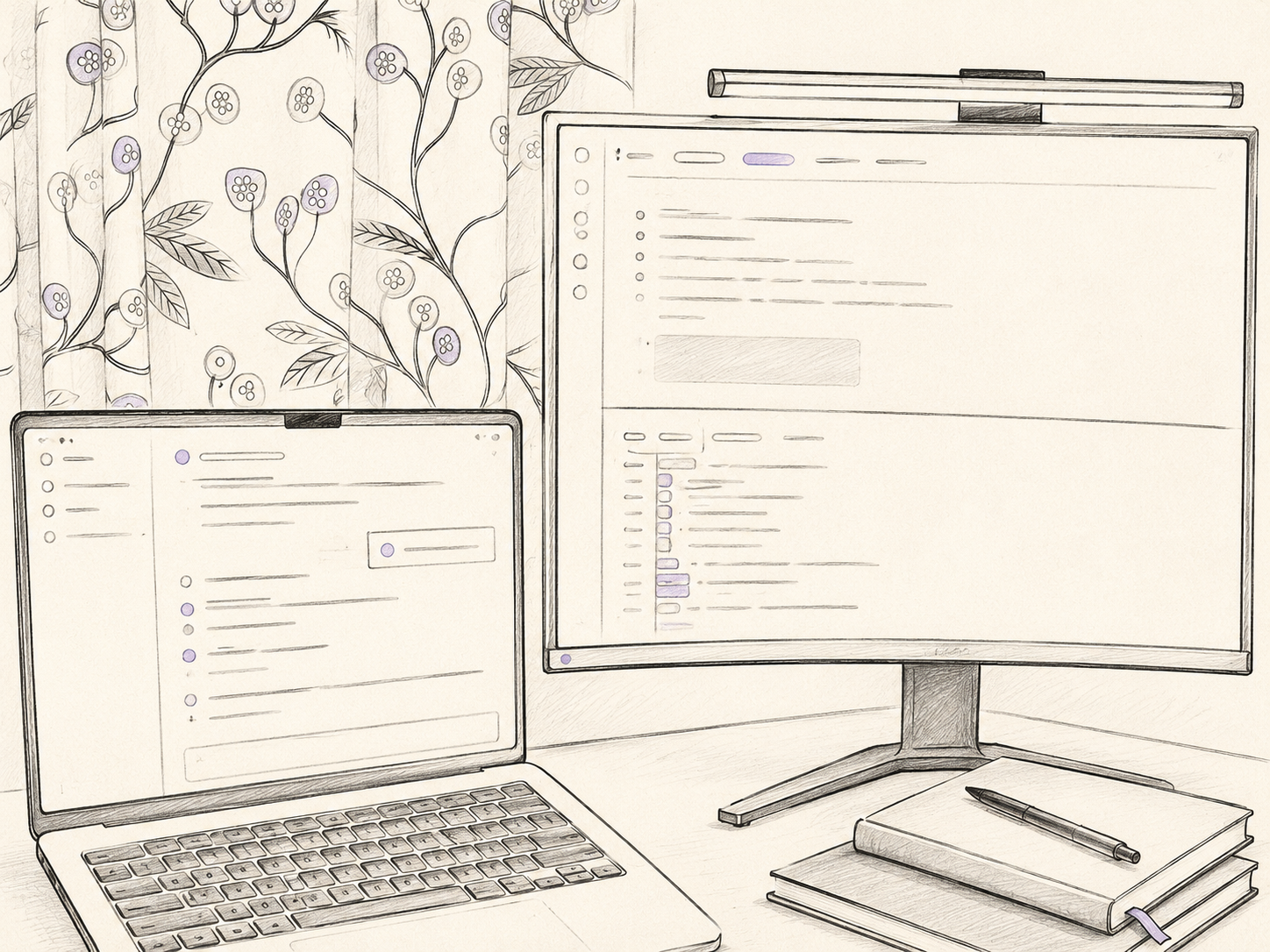
This does not mean education should give up on governing AI. It means we need to stop treating AI as a stable body of content that can be neatly taught, regulated and assessed in the same way as mathematics, chemistry or English. It is not a conventional subject. It is a moving environment.
The most useful thing schools can teach is not how to use one particular chatbot. It is how to think in a world where powerful tools are constantly changing.
The system is trying to catch up, but it cannot lead
Australian education is not ignoring AI. Schools now have national and state-level guidance around privacy, academic integrity, teacher supervision and responsible use. Universities increasingly distinguish between assessments where AI is permitted, assessments where it must be disclosed, and assessments where it is prohibited.
That is an appropriate response. Institutions have legal obligations. They need to protect student data, preserve the credibility of qualifications and give teachers clear boundaries. No school should casually allow students to upload private information into a public AI tool. No university can, in good conscience, endorse a student as industry-ready when their assignments have been completed entirely by AI, while employers reasonably expect those capabilities to be the student’s own.
The issue is not that these policies exist. The issue is that they often assume AI can be contained through rules written after the technology has already changed.
Education works slowly for good reasons. Curriculum reforms require consultation. Assessment changes need moderation. Privacy reviews need to be rigorous. Teachers need time to understand new expectations before being asked to implement them. These processes should not become faster simply because Silicon Valley releases a new product every few weeks.
But AI doesn’t wait.
A student can discover a new workflow on TikTok, Reddit, YouTube or X before their lecturer has heard of it. A tool can move from being a basic chatbot to a coding assistant, a research agent, a design tool or an automated workflow builder in a short period of time. The result is a permanent gap: institutions formalise their response after students have already begun experimenting.
This is why there will never be a truly current, fixed AI curriculum.
Teaching students exactly how to use a particular model is like teaching them the layout of one airport terminal and calling it travel education. It may be useful for a moment. It will not prepare them for the next terminal, the next country or the next problem.
Universities are especially vulnerable to this issue because they often try to make AI legible through structured tasks. In one of my own project-based university classes, a significant portion of the assessment focused on using AI to compare research article summaries. The intention was reasonable: introduce students to AI-assisted research and make them reflect on its use.
In practice, the task was shallow. Students could generate summaries, ask an AI tool to compare them, and assemble the result into a script without demonstrating much independent thought. It did not teach students how to use AI creatively, critically or strategically. It taught them how to complete an AI-related task designed by people who did not fully understand what students could already do with the technology.
That is not an attack on lecturers. It is a structural problem. Most teachers and lecturers are experts in their disciplines, not full-time AI users who spend hours each week testing new tools, agents and workflows. Understanding how a language model works is not the same as knowing how to use it effectively. Knowing how to write an integrity policy is not the same as knowing how AI can reshape a student’s workflow.
There is no stable category of “AI expert” within education. There are only people who remain curious, test tools, learn quickly and adjust when they are wrong.
That is precisely the capability education should be building in students.
AI is an iceberg, and most people are still near the surface
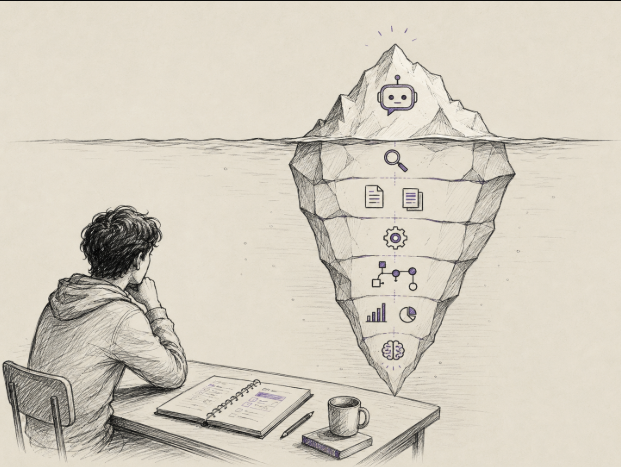
I think of AI adoption as an iceberg.
At the visible surface are chatbots. You ask a question, and the model gives an answer. This is where most people currently sit. They use ChatGPT, Claude, Gemini or another tool to rewrite an email, explain a concept, summarise notes or generate a quick response.
Below that is the level where AI works alongside you. It helps inside documents, spreadsheets, code editors and research workflows. Further down are agents, automations and systems that complete multi-step tasks. At the deepest levels, people coordinate multiple agents and build entire workflows around AI rather than merely asking it isolated questions.
Most people are still using AI at the surface level. Even then, some use it well, but most do not.
At university, I use AI primarily as a tutor and a last resort. When I am struggling with a concept, I might ask it to explain the idea differently, identify a possible mistake in my working or give me a simpler conceptual framework. But I still do most of the learning myself. I do not want the tool to replace the struggle that produces understanding.
AI is often wrong. I have used it to check engineering working, only to realise it had misunderstood the question and calculated the wrong form of stress altogether. That is not unusual. Hallucinations are not a rare technical glitch; they are part of the reality of using generative models. When the answer matters, I check the source material, test the logic or ask a lecturer.
In tutoring, I use AI for tasks I can already judge: generating possible essay topics, transcribing handwriting, checking grammar, developing quick lesson resources and improving the clarity of feedback I have already formed myself. I also helped build a platform that creates VCE-style exams for students, including prompts, topics, images and argument-analysis materials.
That is useful. It saves time. It lets me spend more energy on the parts that require judgment: deciding whether a topic is worthwhile, whether feedback is accurate, whether a student’s idea has depth, and what they need to develop next.
But this is still relatively surface-level AI use.
The larger opportunity is not getting a chatbot to do Excel faster. It is recognising that many things which once required a technical specialist, a software team or significant time can now be attempted by a student with an original idea. A young person can prototype an app, build a website, automate a process, create a study platform, design visual resources or test a business idea with far less technical friction than before.
That is where education is behind.
Students are still being trained to optimise for marks, credentials and the next assessment. They are taught to complete the task in front of them, often very effectively. But fewer are being taught to notice problems worth solving, form an original view, pursue an idea independently and turn that idea into something real.
AI makes this gap more serious. A student with little curiosity can use AI to avoid thinking entirely. They can outsource the first draft, the second draft and eventually the intellectual work itself. They may achieve a result that looks competent on paper while developing almost none of the underlying capability.
At the same time, a student with strong ideas, discipline and judgment can use AI to become dramatically more productive.
This is the uncomfortable truth: AI can make disengaged students more dependent, while making capable students more capable. The technology does not automatically create innovation. It amplifies the habits already present.
The danger is not only cheating. It is intellectual passivity.
The usual education conversation about AI focuses on cheating. That concern is real.
Uninvigilated take-home work can no longer reliably prove that a student wrote every word without assistance. AI detectors do not solve this problem. They can produce false positives, particularly for students whose writing is naturally formal, controlled or less stylistically chaotic. Treating an AI-detection score as conclusive evidence is dangerous because it risks accusing students based on probability rather than proof.
The honest response is that some forms of assessment are now difficult to authenticate.
For tasks that require independent reasoning, schools and universities need to accept that the most reliable option remains controlled, in-person assessment. Pen-and-paper writing, supervised problem-solving, oral presentations, practical demonstrations and invigilated examinations are imperfect, but they establish a clearer connection between the student and the work.
There are subjects where this matters deeply. Medicine, science, engineering and other fields require students to retain core knowledge and reasoning ability. You cannot safely become a doctor by outsourcing every diagnosis to a model. You cannot become an engineer by accepting calculations you do not understand. AI may help professionals work faster, but it cannot carry responsibility for their judgment.
English is more complicated.
English should be one of the best subjects for developing original thought, expression and critical interpretation. It should reward students who can see ideas others miss, build arguments with nuance and communicate an individual perspective. Yet it is also one of the easiest subjects for AI to imitate.
This creates a strange paradox. As an English tutor, I encourage students to write their own work because the thinking process matters. The strongest students I teach produce genuinely original ideas because they have had to develop them themselves. That capability will remain valuable.
But I also think students need more exposure to AI, not less.
The solution cannot be pretending AI does not exist. Students will use it privately anyway. They will learn from social media, friends and unreliable online advice. The most confident users will gain an advantage, while students who lack access, confidence or guidance will fall further behind.
Stigmatising AI does not stop AI use. It sends it underground.
Schools should instead create a supervised environment where students can experiment openly, learn what AI can and cannot do, and understand why outsourcing thought is strategically self-defeating.
Teach adaptive literacy, not fixed procedures
Universities already teach students about prompting: give context, clarify the task, specify the format, refine the response. That advice is not useless. But it is not a durable curriculum either.
What worked with one model last year may work differently with another model this year. Interfaces change. Tools become more capable. Some workflows disappear. Others become automatic. A checklist of “good prompts” will age quickly.
The enduring skills are more fundamental.
Students should learn how to evaluate whether an AI output is credible. They should learn how to identify missing assumptions, biased framing, weak evidence and fabricated information. They should understand data privacy, intellectual property and the difference between using AI for ideation and using it to impersonate their own work.
They should also learn how to decide when not to use AI.
Sometimes the most efficient workflow is not the best learning workflow. A student who asks AI to solve every difficult problem may save time today while becoming weaker tomorrow. Productive AI use requires knowing whether the objective is to produce an answer, learn a skill, test an idea or demonstrate independent competence.
This isn’t technical training. It’s epistemic training: teaching students how to know what they know, how to question a confident answer and how to retain ownership of their reasoning.
An effective AI-allowed assessment would reflect this.
Imagine a VCE English or university communication task where students are asked to develop a public-facing campaign, research brief or original response to a contemporary issue. They could use AI to brainstorm, test structures, generate alternative wording, explore visual concepts or prototype a digital product. But they would submit a clear declaration of how AI was used, alongside their final work and a short oral defence.
The oral defence would not be a trap. It would ask students to explain their key decisions: why they rejected certain AI suggestions, how they verified claims, what they changed, and what remains distinctly their own contribution.
This would assess what actually matters in an AI-rich environment: judgment, originality, evaluation and communication.
In contrast, an AI-free task should be used when the learning outcome is unaided reasoning. A timed, supervised task can test whether a student can independently analyse a text, solve a problem, recall essential knowledge or communicate under pressure. It should not be treated as an outdated punishment. It is simply a different assessment mode for a different purpose.
The current mistake is trying to force every task into the same grey zone. Either AI is vaguely allowed but students fear being accused of using it, or it is vaguely prohibited despite being impossible to police outside a controlled setting.
Clarity is more useful than performative strictness.
The future belongs to students who keep learning
The capabilities that will matter most over the next fifteen years are not simply technical.
Technical execution will become more accessible. That does not mean technical knowledge will become worthless; it means routine technical work will be increasingly assisted, accelerated and commoditised. The advantage will shift toward the person who can decide what should be built, why it matters and whether the result is good.
Students will need to be progressive learners: people open to new tools who can teach themselves without waiting for a curriculum to catch up.
They will need to think outside the box: not merely completing a defined task, but noticing neglected problems and approaching them differently.
They will need originality: the ability to form an idea that is more than an average summary of existing information.
They will need intellectual humility: the willingness to revise their view, admit uncertainty and avoid becoming arrogant after early success.
And they will need judgment: the ability to distinguish a polished answer from a good one, a confident claim from a reliable claim, and a useful tool from a distraction.
That is innovation.
Innovation is not necessarily inventing the next billion-dollar company. It is seeing a problem clearly, forming a better way of approaching it and having the initiative to build, test or communicate a solution. AI now gives students a greater ability to act on those ideas. The limiting factor is no longer only whether they can code, design or access a large team. It is whether they can think beyond the obvious.
There is a legitimate argument against this approach. Open AI experimentation could normalise cheating, deepen inequality between students with different access to tools, overwhelm teachers and allow corporations to turn classrooms into testing grounds for new products.
Those risks are not imaginary. They are exactly why schools need strong privacy rules, clear assessment boundaries and teacher oversight.
But the answer cannot be retreat. The world outside school will not pause while institutions decide whether AI is comfortable. Students who are told only “do not use it” will still encounter it. The difference is that they will encounter it without guidance, without ethical frameworks and without anyone challenging them to use it for something more meaningful than avoiding homework.
The purpose of education should not be to preserve a world before AI. It should be to prepare students to remain capable within the world that exists.
Australia does not need a generation of students who can memorise a 2026 AI policy or follow a static list of approved prompts. It needs students who can navigate unfamiliar tools ten years from now, question their outputs, retain their own thinking and turn original ideas into real work.
The technology will keep moving.
Education should stop pretending it can catch it.