When the Future Changes Before You Arrive
AI is reshaping careers faster than students can graduate into them. But the question isn't whether our pathways will change — it's whether we understand our ambitions well enough to carry them through.
When the promised pathway stops feeling stable
There’s this particular manifestation of anxiety that comes from watching the future evolve before you have even arrived in it.
For a vast majority of my life, the pathway seemed relatively clear. You studied something difficult, built eventual competency around it, found an entry level position for it, then spent many years becoming useful at this particular skill. Expertise was an accumulation of time, effort, and commitment. The work that you completed in university might not have made you an engineer yet, but it was at least moving you closer to becoming one.
Yet, artificial intelligence has made that progression feel less certain.
Every few months, another model arrives with a new name, and a collection of new abilities: GPT-5.6 Sol, Claude Fable 5, Kimi K3, Grok 4. OpenAI now describes its flagship model as capable of handling long-horizon engineering work in real codebases, while Anthropic and Moonshot AI make similar claims about agentic coding and extremely complex knowledge work. (OpenAI, 2026; Anthropic, 2026; Moonshot AI, 2026)
The models are not perfect. They hallucinate, misunderstand context, and occasionally produce completely incorrect answers with absolute confidence and little connection to reality. Yet, this imperfection is no longer comforting to me. A technology doesn’t have to be flawless to transform an industry. It only needs to become useful enough.
Cheap enough.
Reliable, enough.
And that’s enough for companies to restructure work around it.
That is unsettling when you are still learning the work it may restructure.
I study engineering, and much of my degree is built around learning how physical systems behave: materials deforming under stress, how energy moves through thermodynamic systems, how force produces motion, and how design decisions may affect the safety of a much larger project. They’re not trivial ideas. These take time to learn, understand and conceptualise. They take even longer to apply properly.
But, the distance between knowing nothing, and creating something that looks competent is collapsing.
In 2025, researchers at the University of Illinois tested whether ChatGPT could complete an entire undergraduate aerospace control-systems course under a deliberately low-effort protocol. Questions were mostly copied directly into the model without expert prompting. Across 115 deliverables, it achieved 82.24 per cent, only slightly below the class average of 84.99 per cent. It struggled most with open-ended projects, but performed strongly on structured assignments, mathematical formulations and programming tasks (Puthumanaillam, Bretl, & Ornik, 2025).
This is not to say that ChatGPT understands engineering in the same way in which a professional engineer does. It does not need to live with the consequences of a failed design. It does not stand beside a machine it helped construct, and listen for a noise that should not be there. But, it can produce enough correct work to blur the boundary between someone who has learned a concept, and someone who has learned to ask for it.
This changes the meaning of being a beginner.
Studies of generative AI in the workplace reportedly find that the largest productivity gains often go to the least experienced workers. Brynjolfsson, Li and Raymond examined more than 5000 customer support agents, and found that access to an AI assistant increased productivity by around 15 per cent overall. For less experienced and lower-skilled workers, the improvement was substantially larger. The system appeared to transfer some of the patterns used by top performers to those who had not yet developed these skills independently (Brynjolfsson, Li, & Raymond, 2025).
A controlled experiment involving GitHub Copilot produced a similar result. Developers using the AI assistant completed a programming task 55.8 per cent faster than those working without it, with the researchers suggesting that the technology could make software development more accessible to people with less experience (Peng et al., 2023).
On one hand, this is exciting. A first year engineering student can now receive explanations, generate simulations, and prototype basic applications and ask unlimited follow-up questions, without waiting for a tutor, or a lecturer. Someone with enough curiosity can build things far beyond what their formal education would normally allow at that stage.
But, on another level, this raises far more uncomfortable questions. Where does that leave the person who spent years becoming capable of doing those things without assistance?
Right now, I can perform stress and strain calculations, reason through basic thermodynamic systems and understand how those calculations affect an engineering project. But a younger student with strong AI proficiency may be able to produce a working approximation of the same analysis within minutes. They can connect models to software, create specialised agents and automate parts of a workflow that took me several semesters to understand.
Sure. Their understanding may be shallower. Their solutions may contain mistakes that they do not comprehend. But employers do not always need a perfect understanding of a system. Sometimes, they require an acceptable output that is delivered quickly.
This is why the fear surrounding AI is not simply the fear of losing a job. It is the fear of becoming less valuable before having the chance to become useful.
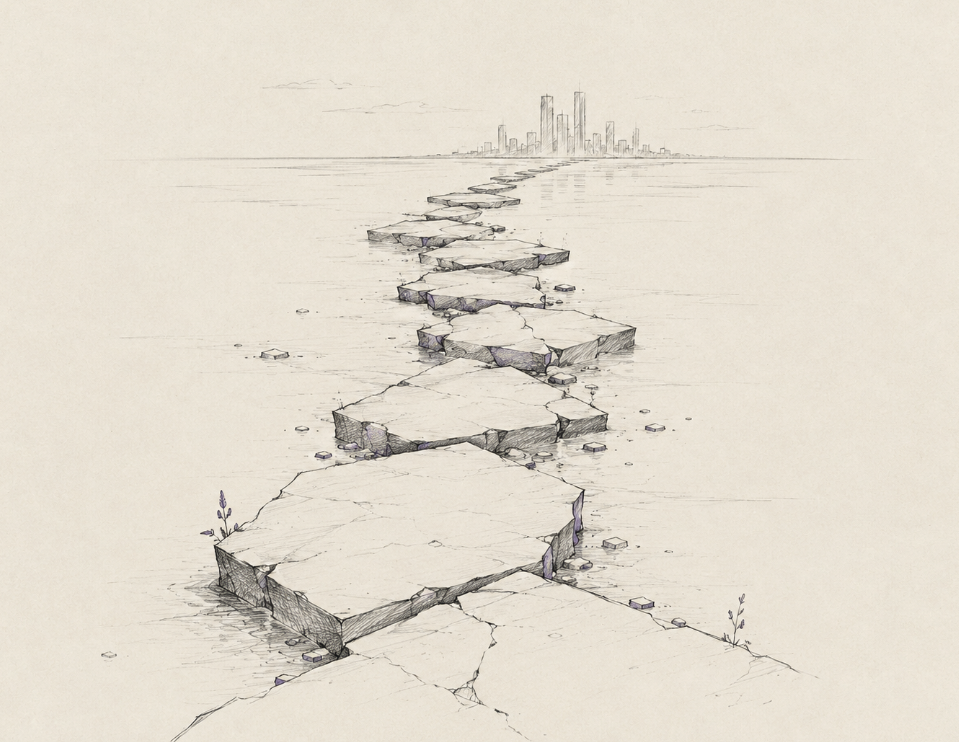
When the ladder’s first rungs disappear
Entry-level work has traditionally been inefficient by design. Junior employees are given smaller tasks, corrected by senior staff and gradually bestowed with more responsibility. Their early work does not merely produce output; it produces the experienced workers a company will need later.
Internships operate through the same logic. An intern is not hired because they are already as productive as an experienced engineer. They require training, supervision and time from people whose hours are more expensive than theirs. In the immediate sense, this may be less efficient than assigning the work to an established employee or an AI system.
Yet companies continue to run internship programs because capability has to come from somewhere. The National Association of Colleges and Employers reported that 63.1 per cent of interns in its 2024-25 employer sample converted into full-time employees. The acceptance rate for those offers reached 88.3 per cent. Internships were not treated merely as temporary labour, but as a way of identifying and developing future employees (NACE, 2026).
I would like to believe that companies will continue offering these positions partly because they recognise a moral responsibility to the next generation. Realistically, morality is probably not enough. Internships will survive where organisations understand that eliminating every inefficient beginner also eliminates the future expert they were supposed to become.
Software engineering already provides a warning.
For many years, computer science was presented as one of the safest investments a student could make. Learning to code, obtain a degree, enter a growing industry, and slowly working upwards. It was more than just a career pathway but a message for us students, promising that difficult study would translate into stability.
That promise has weakened. SignalFire’s analysis of hundreds of millions of professional profiles found that new graduates represented only 7 per cent of Big Tech hires in 2024. New-graduate hiring had fallen by more than 50 per cent compared with 2019, while the share of graduates from leading computer-science programs entering the largest technology companies had more than halved since 2022 (SignalFire, 2025).
It is important to acknowledge that AI is not entirely responsible for this. Technology companies overhired during a period of cheap capital and extraordinary digital growth. Higher interest rates, coupled with post-pandemic corrections and tighter budgets have all contributed to this. It would be convenient, but inaccurate, to attribute every disappearing graduate program to AI.
Nevertheless, AI still has its own impact. Many tasks historically given to junior software engineers, such as drafting routine code and debugging simple issues, can now be accelerated or partly completed by a senior engineer working in conjunction with an AI system.
This produces what SignalFire calls the “experience paradox”: companies want workers who can immediately provide high-leverage output, but the opportunities through which inexperienced workers once became capable of producing that output are narrowing.
Recent research describes an even deeper problem. After interviewing junior and senior software engineers, Yu and Moon argued that generative AI may be absorbing not only entry-level tasks, but also the “productive struggle” through which beginners develop expertise. When senior workers complete junior work through AI-assisted workflows, the organisation receives the output, but the junior loses the experience that would have helped them become senior (Yu & Moon, 2026).
The ladder has not disappeared entirely. But some of its lower rungs are becoming harder to find.
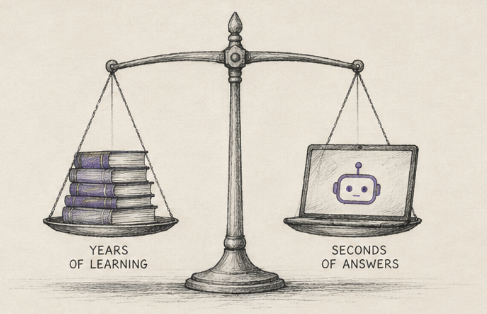
Living on AI’s jagged frontier
Engineering is not immune. AI systems are already being developed to generate parametric parts, interpret engineering drawings and create CAD models from natural-language descriptions. The progress is real, although less complete than online demonstrations often imply. Current benchmarks find that models can handle simpler geometry but deteriorate as topology, manufacturability and assembly constraints become more complicated. Even the strongest systems still struggle to produce consistently valid, editable and engineering-ready designs (Dong, Li, & Wu, 2026; Doris et al., 2026; Wang et al., 2026).
This is the strange position AI occupies today. It is capable enough to make the future feel unstable, but unreliable enough that nobody can confidently describe what that future will be.
This is what researchers have dubbed the “jagged technological frontier”. In an experiment involving hundreds of consultants, Dell’Acqua and colleagues found that AI substantially improved performance on tasks that were well within its capabilities. Participants were able to complete more work, producing much faster, higher quality outputs. But, when tasks fell outside the AI’s capabilities, users were more likely to produce incorrect answers because they trusted it in situations where it was not well suited (Dell’Acqua et al., 2025).
Even the productivity story is less straightforward than it first appears. In a randomised study of experienced open-source developers working on codebases they knew well, AI tools made them 19 per cent slower. The developers had expected to become faster and still believed they had become faster after completing the study. In reality, time spent prompting, waiting, reviewing and correcting AI-generated code outweighed the benefits (Becker et al., 2025).
So, it isn’t that AI is useless. It is that its value depends heavily on the task, the worker and the surrounding system. Sometimes, it compresses years of experience. Sometimes, experience is precisely what allows someone to recognise when the AI is wrong.
Nonetheless, the frontier keeps moving.
Separating a job title from the real dream
In 2024, one of the most repeated jokes about large language models was their inability to count the number of times the letter “r” appeared in “strawberry.” A year later, an accessible model could achieve a B grade across an undergraduate engineering course. By 2026, models were being evaluated on long-horizon coding, scientific reasoning and computer use, while researchers were producing systems capable of generating simple CAD components and experimental assemblies.
What will they be capable of when I graduate?
What will they be capable of in 2030, after I have spent several years trying to become professionally competent? What about 2035, when I am supposed to be approaching the stage where organisations trust my judgement?
I do not know. Nobody does.
That uncertainty makes conventional career planning feel fragile. It is difficult to confidently commit to a ten-year pathway when the work at the end of it may be reorganised several times before you arrive.
But perhaps the problem is not that our dreams have become impossible. Perhaps, we have muddled the pathway and the dream itself.
A job title is usually only the visible surface of a deeper ambition.
Someone may say they want to become an engineer, but what they really want is to understand how things work and use that knowledge to solve physical problems. Someone may want to become a writer because they want to express ideas clearly enough to change how another person sees the world. Someone may want to become a doctor because they want to care for people, understand the body and make difficult decisions when those decisions matter.
The profession gives the ambition a structure. It is not necessarily the ambition itself.
This distinction matters because AI may transform the structure without destroying the underlying purpose. Engineering may involve less manual calculation and more validation, system integration and responsibility for AI-generated designs. Writing may involve producing fewer first drafts and making more decisions about voice, meaning and what deserves to be said. Medicine may incorporate increasingly capable diagnostic systems while placing greater importance on communication, consent and judgement under uncertainty.
The job changes. But the reason for the ambition will remain.
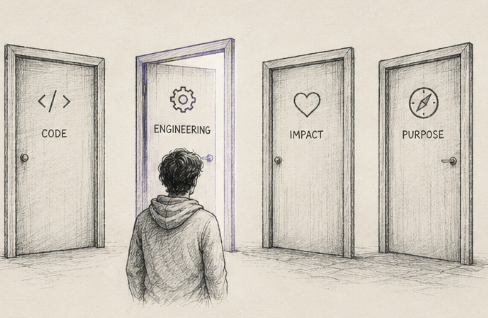
Psychological research offers a useful way to understand this. A study on concordant goals found that people are more likely to sustain effort and gain wellbeing from success when their goals reflect their underlying interests and values, rather than external pressures or status (Sheldon & Elliot, 1999).
A goal such as becoming a mechanical engineer may therefore contain several layers. The external layer is the title. The salary. The recognition. Beneath it may lie the desire to create useful things, comprehend complex systems, earn stability or contribute to projects that have a larger impact on society.
Just because the external appearance changes, the deeper motivations do not automatically disappear.
Flexibility without pretending nothing is lost
This does not mean people should respond to disruption with empty optimism. Telling a student that “there will always be jobs” is not a serious answer when entry-level pathways are already narrowing in some industries. Nor is it enough to say that humans will simply focus on “more creative work,” as though every displaced administrative employee can effortlessly become a strategist or designer.
Adaptation involves loss. Some careers will become smaller. Some skills will receive less financial value than the effort required to learn them. Some people will discover that the opportunity they prepared for no longer exists in the form they expected.
The healthier response is not blind persistence, but flexibility.
Research on goal adjustment suggests that wellbeing depends partly on a person’s ability to disengage from goals that have become unattainable and redirect effort towards meaningful alternatives. This is not the same as abandoning ambition. It is the ability to stop treating one particular method as the only acceptable route towards a worthwhile life (Wrosch, 2013).
A disappearing pathway does not necessarily mean the destination has disappeared.
When adaptability turns into losing the plot
At the same time, there is a danger in adapting too aggressively.
Current conversations surrounding AI often encourage people to chase whatever appears most employable: learning the newest model, building agents, automating workflows, becoming an AI engineer, and repeating the process when the next tool arrives three months later. Adaptability becomes an endless race to stay “technologically proficient.”
But a person can adapt so frequently that they eventually lose sight of what they are adapting for.
If I abandon engineering because coding seems safer, then abandon coding because AI can generate software, then move towards whatever new field seems temporarily protected, I may remain employable whilst becoming increasingly disconnected from anything I truly wanted.
At some point, this doesn’t look like adaptability at all. It becomes a re-modernised version of millions of people drifting into careers they dislike, held in place by a steady paycheck and the vague fear that anything else would be worse.
There must be a difference between changing direction and allowing the market to choose your entire identity.
What we, humans, still have to decide
The goal should not be to make ourselves endlessly interchangeable. It should be to become capable of carrying a meaningful purpose through changing circumstances.
That will still require technical ability. The claim that knowledge no longer matters because AI can retrieve it misunderstands what expertise does. An engineer who understands mechanics is better positioned to recognise when a generated calculation violates physical reality. A programmer who understands system architecture can distinguish working code from a system that will collapse under scale. A doctor with deep clinical knowledge can interpret a recommendation within the patient’s history rather than treating it as an isolated prediction.
AI may reduce the value of producing the first answer. It may increase the value of knowing whether that answer deserves to be trusted.
The OECD’s analysis of occupational capabilities reaches a similar conclusion. Current AI systems are closest to work involving routine information processing and codifiable tasks. They remain further from work requiring contextual judgement, interpersonal understanding, complex decision-making and responsibility (OECD, 2026).
These qualities are sometimes dismissed as “soft skills,” as though they are decorative additions to real technical competence. In practice, they are what determine whether technical competence is applied appropriately.
An AI system can generate several designs. Someone still has to decide which design should exist.
It can optimise a structure against a set of constraints. Someone still has to decide whether those constraints represent reality.
It can recommend a course of action. Someone still has to accept responsibility for what happens next.
That responsibility cannot simply be claimed whenever humans perform well and transferred to the machine whenever they do not. If AI becomes embedded in professional work, the human role may increasingly involve defining objectives, understanding consequences and standing behind decisions produced through systems no individual person completely controls.
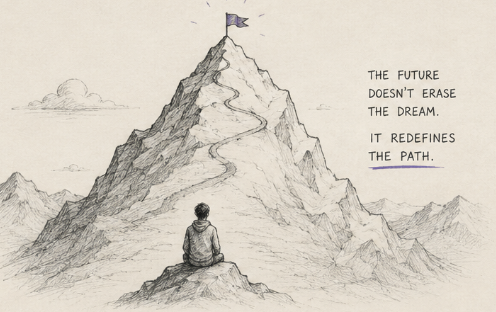
Carrying judgement
This may be less comforting than the false notion that human creativity will magically protect us. Judgement is difficult. Responsibility is heavy. It is much easier to complete a calculation than to decide whether a project should proceed despite uncertainty.
Yet perhaps this is where the work was always heading. The purpose of learning engineering was never merely to become a slower calculator. It was to develop enough understanding to make decisions about real systems whose failures have real consequences.
The value of my education cannot rest on doing calculations faster than a machine. It has to lie in the cognitive capability that lets me question outputs, connect decisions, and recognise when a technically correct solution is practically wrong.
My dream may need to become more flexible. It does not need to become smaller.
There is no way to perfectly protect a career from technological change. Even occupations that appear resistant today may be reorganised by systems that do not yet exist. Building a future around the assumption that one particular task will always belong to humans is therefore a fragile strategy.
A stronger future begins by asking a more difficult question: what did I actually want from this career?
Did I want the title, or did I want the opportunity to solve problems?
Did I want to perform a particular task, or did I want to become someone capable of creating useful things?
Did I want certainty, or did I want a life in which my abilities mattered?
The answers will not remove the disruption. They may, however, reveal which parts of the dream can change and which parts are worth carrying forward.
Perhaps the future is not asking us to abandon our dreams, but to understand them well enough that they can survive becoming unrecognisable.
References
- Anthropic. (2026). Introducing Claude Fable 5 and Claude Mythos 5. Anthropic.
- Becker, J., Rush, N., Barnes, E., & Rein, D. (2025). Measuring the impact of early-2025 AI on experienced open-source developer productivity. arXiv preprint arXiv:2507.09089.
- Brynjolfsson, E., Li, D., & Raymond, L. R. (2025). Generative AI at work. The Quarterly Journal of Economics, 140(2), 889-942.
- Dell’Acqua, F., McFowland, E., Mollick, E. R., Lifshitz-Assaf, H., Kellogg, K. C., Rajendran, S., Krayer, L., Candelon, F., & Lakhani, K. R. (2025). Navigating the jagged technological frontier: Field experimental evidence of the effects of AI on knowledge-worker productivity and quality. Organization Science.
- Dong, X., Li, Z., & Wu, X.-M. (2026). MUSE: Benchmarking manufacturable, functional, and assemblable text-to-CAD generation. arXiv preprint arXiv:2605.28579.
- Doris, A. C., Sony, J. T., Nehme, G., Syla, E., Nobari, A. H., & Ahmed, F. (2026). CADBench: A multimodal benchmark for AI-assisted CAD program generation. arXiv preprint arXiv:2605.10873.
- Moonshot AI. (2026). Kimi K3: Open frontier intelligence. Moonshot AI.
- National Association of Colleges and Employers. (2026). 2026 Internship & Co-op Survey. NACE.
- OECD. (2026). AI and work. Organisation for Economic Co-operation and Development.
- OpenAI. (2026). GPT-5.6: Frontier intelligence that scales with your ambition. OpenAI.
- Peng, S., Kalliamvakou, E., Cihon, P., & Demirer, M. (2023). The impact of AI on developer productivity: Evidence from GitHub Copilot. arXiv preprint arXiv:2302.06590.
- Puthumanaillam, G., Bretl, T., & Ornik, M. (2025). The lazy student’s dream: ChatGPT passing an engineering course on its own. arXiv preprint arXiv:2503.05760.
- Sheldon, K. M., & Elliot, A. J. (1999). Goal striving, need satisfaction, and longitudinal wellbeing: The self-concordance model. Journal of Personality and Social Psychology, 76(3), 482-497.
- SignalFire. (2025). The SignalFire State of Tech Talent Report 2025. SignalFire.
- Wang, L., Meng, H., Xiang, Z., Liu, J., Zhou, P., Chen, L., & Tang, Y. (2026). Text2CAD-Bench: A benchmark for LLM-based text-to-parametric CAD generation. arXiv preprint arXiv:2605.18430.
- Wrosch, C. (2013). Goal adjustment capacities, subjective wellbeing, and physical health. Social and Personality Psychology Compass, 7(12), 847-860.
- Yu, S., & Moon, T. (2026). Who will become the next senior? How generative AI erodes the development pathway in software engineering. arXiv preprint arXiv:2607.17067.